Showing posts with label quotables. Show all posts

Monday, July 5, 2010

A House Divided...

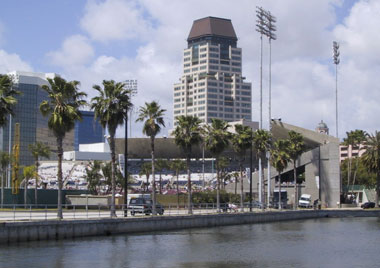
In 1990, a decades-old dream was finally realized. It started with a visionary named Albert Lang, who, way back in 1914, decided he wanted something to help bolster the tourism and appeal of the bayside hamlet of which he was the visionary mayor. Then, sixty years later, the leaders of the now-burgeoning city realized St. Petersburg's best days were behind them: crime was rampant in the southern and downtown parts of the city, and the northern reaches were relegated to nothing more than over-glorified retirement communities. The tax base was way down for even the most basic of emergency services, thereby straining the coffers to the point of breaking. "White Flight" was just as prevalent here as it was in the Rust Belt. Something needed to be done, and they had an epiphany: they needed to use the one thing that still brought the people back every spring and make it a more permanent fixture, bringing people here to spend their money in the dead of summer so they can realize it's not a bad place to live and bring their money with them full-time.

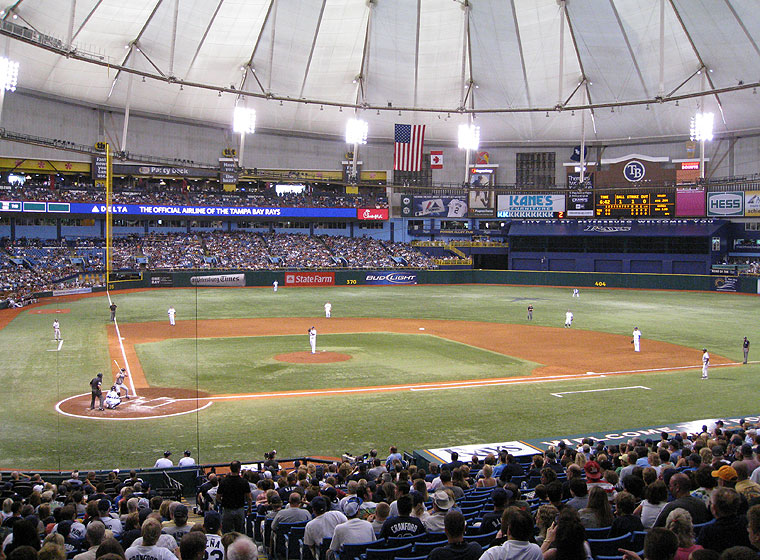
Thus, the Florida Suncoast Dome was born. Of course, like Rome, it wasn't built in a day - or a decade for that matter. But eventually, after much fighting regionally between St. Petersburg and its bigger sister across the bay, Tampa, and in-fighting within St. Pete's city limits itself, a site - and a design - was finally chosen. Fast forward back to 1990, and the builders, city leaders, and design critics all call the lopsided dome with concentric, self-supporting rings holding its roof aloft "the stadium for the 21st Century." It's the jewel of St. Petersburg - even though the then-commissioner of Major League Baseball told the city that just because they build it, they won't necessarily come - and a state-of-the-art masterpiece in all of its air-conditioned glory.

Then, Camden Yards is built....

Now, the stadium that was built only two short years prior - the year in which the dome (now renamed the Thunderdome) is inhabited by both the NHL's Lightning and AFL's Storm - is now "functionally obsolete" for the original purpose it was built, a sport that hadn't even been awarded to the area yet and won't be for another four years. Everyone "in the know" now wants their very own Camden Yards in their downtowns; apparently, what works in one city is a goldmine everywhere, or so the thinking goes.

So, with that in mind, the 9th-newest stadium in Major League Baseball when the Rays first took the field is today the 9th-oldest (soon to become the 8th-oldest in 2012 with the opening of the Marlins' new house in Little Havana). Tropicana Field, as it's now called, is a relic long before its time. By declaring his intentions on June 21, Stu Sternberg has said, without a shadow of a doubt, that the Trop is done and needs to be replaced. And, he's not mincing words, either:
“Baseball in the Tampa Bay area does not belong to Stu Sternberg, just as it doesn’t belong to St. Petersburg or Tampa, Pinellas or Hillsborough. It is a regional asset. It belongs to our fans throughout the region. For this asset to be preserved, a comprehensive process to explore a new ballpark must begin."
So, as you can see, he's trying to force "regional cooperation" in determining the next site of the Rays base of operations. Personally, I'd love to see that myself, because for far too long, Tampa and St. Pete have acted like fierce rivals in some sort of chess match for total domination of the region. However, as a St. Petersburger, I can understand why residents on this side of the water feel constantly at-war with their neighbor to the northeast.

We are not like other "twin cities" in the country, namely Minneapolis/St. Paul and Dallas/Fort Worth. In those regions, they work together more than just philosophically; they share tax revenue from the areas' attractions - including their sports teams - along with spending money equally for regional services. Even now, here in Tampa Bay regional transit is beginning to take shape...with each county paying its own way, but only if the citizens of those counties vote to approve it at all in their borders. We do not cooperate like the Twin Cities or the Metroplex because we prefer to act independent - and bitch about it later when we can't afford luxuries we became accustomed to anymore.

When St. Petersburg built the Suncoast Dome 20 years ago, it was with St. Pete and Pinellas County money. Tampa brought nothing to the table, nor did Hillsborough, Manatee, Pasco, or any other county government for that matter. Basically put: if St. Pete loses the Rays, we lose not only a team or a piece of our civic pride, we also lose the money brought to this city by them each and every year since we were the only ones to bear the financial burden. This city and county had to go it alone, and sadly, this is how pretty much any public works project goes around here, and until that mentality changes, I can completely appreciate why the city of St. Pete refuses to listen to a suit from New York tell them how to "cooperate".

However, that leaves only three options to solving this mess, and none involve the lame - and tired - argument of "enforcing the contract through 2027 via legal proceedings"; let's face it: if the Seattle SuperSonics, original Cleveland Browns, and Baltimore Colts can all get out of their contracts relatively unscathed, so too can the Rays:
  1. St. Petersburg must come to the table with a kickass proposal to be located in the Trop's current parking lot - something that will satiate Stu's wanderlust - while understanding we're going to have to probably front about 67% of the costs; not doing this will cause the city to lose a massively substantial tax base and, by extension, lose even more city services,
  2. Tampa and St. Petersburg - along with all the surrounding counties, as well as others in the demographic area (Polk, Hernando, Sarasota, Citrus, Sumter, Hardee, and Desoto) - need to finally put "regional differences" aside, realize we need each other to survive in the 21st Century against the Charlottes, Austins, and Portlands of the country, and start working on a regional sales tax to pay for public works projects that affect more than 60% of the metro's population base, such as public transit, tourism advertising, and (yes) stadiums, or
  3. Pack Evan Longoria's bags for him to move with the team to Norfolk/Virginia Beach, San Antonio, or Vancouver (What? Canada's hungry for another team!).
That all said, we're really not left with many choices. As much as Stu Sternberg is being vilified by the region (myself included) for telling us how to run our lives, his concise assessment may actually be something that will help us all much sooner than anyone expected. He said something that needed to be said for a long time, but no one has the muscle - or balls - to say it until now: we're a broken region with our petty parochialism. It's our own fault, though, but now's our chance to shine and make up for the shortsightedness of our parents. What was seen as a good idea with "home-rule" in the '50s is holding us back from becoming the next great region today.

However, tomorrow's another day, and hopefully we'll have come a long way by then. Hell, at least our grandparents had enough foresight to fly the world's first commercial "airline", as well as build the then-world's longest bridge, all in attempt for cross-bay cooperation. Maybe we can take a lesson from them instead and put it to use in 2010....

Sunday, April 4, 2010

Breaking Up is Hard to Do

So, another baseball season starts tonight. Gone are the dark days - between the Super Bowl and Opening Day - of being forced to watch random basketball games on TNT and ABC to pass the time (I, personally love hockey, so I will not call it, as John Saunders - a Canadian and avid hockey fan himself, I might add - from ESPN's Sports Reporters recently mused,
"Hockey will always be sports' ugly step-sister. Even those who don't really care seem to go out of their way to dislike the game."
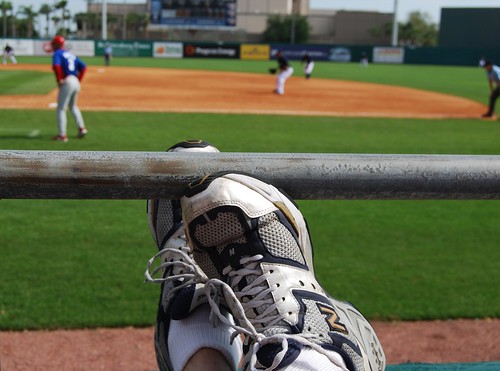
Though, sadly, I can see his point most other Americans' attitudes of indifference toward it.) and watching the same exact dunk or 3-point shot on SportsCenter every waking moment. The smell of grass, hot dogs, and Cracker Jacks have been hot and heavy in the air for a few weeks now with spring training steadily progressing in Florida and Arizona. And starting tonight, the Boys of Summer will return to their homes, be them ancient temples to the Baseball Gods, modern works of art, hyper-expensive replicas of their former selves, or impressive domes people love to hate, and we will be watching. But, do the overblown economics really dictate the game as much the press - and the fans of the smaller-market teams - lead you to believe? Have the fortunes of all 30 teams really been decided before the games even count? If you listen to what Bud Selig tells you, yeah, and something needs to be done about it.

With the first pitch of the season being thrown in Boston against (who else?) dem Yanks, the chatter around the League right now is creating something of an obscure idea here in North America, but common in the rest of the world in their football leagues: rotating leagues. Now, all four North American major sports leagues (as well as lesser ones, like Major League Soccer and the Arena Football League) keep a static form of divisions; that is, they stay in the same league and division until the powers-that-be decide - for any myriad of reasons, ranging from geographical considerations to scheduling balance - to make a change. Over in Eurasia, however, what league you are playing in in any given year depends on how well or poorly you did the year prior. If you were the champion of Division II last year, you can move to Division I to try and see if you can win that one, too. If you sucked in Div. I after moving up, well, be thankful your team isn't being sent to Div. III instead.

Though MLB's proposal isn't as radical (no, teams like the Mets won't be sent to the Minors, though if they were, they'd probably be better off going straight to the Single-A Sally League), it would allow teams that are in "rebuilding years" - excluding the Mets - to move to a higher-grossing division to get more revenue share for said rebuilding by swapping with teams that are constantly competing against powerhouses and falling just short. The best example of this would be putting the Oakland A's in the AL "East" and letting the Tampa Bay Rays play in the AL "West" so they both get what they want: the A's would get more money for better players and a healthier future, while the Rays would have a chance at a division title without relying on the bad luck of other teams to make it happen (let's face it: the Rays were phenomenal in 2008, but the Yanks were just plain bad, which allowed the Rays to exploit that and make it to the Promised Land).

Proponents say, since a salary cap isn't in the cards anytime in the near future, this is the closest to parity we can get in baseball right now. I'm in the camp with the opponents, however. I believe constantly moving teams around year-to-year not only wreaks havoc on the schedule, but also fragments rivalries, which is truly what puts people in the stands. It also puts an undue burden on the team, causing them to under-perform. No longer is it a simple jog up the East Coast to play the other teams in the division; you're now flying out west for 36 games a year, playing with jet-lag 24 games more than the norm. Anyone who has crossed the country once had a hard enough time acclimating to the change once; imagine your own performance doing that up to 12 times in a 5 month period. No one should have to work under those types of conditions, even athletes.

A much better - and more controversial - solution would be to break up the two toughest teams in baseball, who are locked in eternal grudge match while the rest of the division suffers. Yes, I am talking about the AL East's Yanks and Red Sox. Yes, geographically, they are in the correct division, but by virtue of their bottomless wallets, they have pretty much owned the AL East and, by virtue of 2nd place in the division, the AL Wild Card for all but 7 of the 15 years the current format has been in play (1997 Orioles and 2008 Rays each won the division, and 1996 O's, 2000 Mariners, 2001 A's, 2002 Angels, and 2006 Tigers each won the WC). That means, more than half the time, both the Yankees and Red Sox will both be in the playoffs while the rest of the teams are on the sidelines.

The current system penalizes mid-market teams. Not every team has a ravenous fan base like New York and Boston, and the longer they're allowed to control the only two spots into the playoffs, the more it hurts the other teams by lost revenue streams in October and smaller fan bases at the perception of constant mediocrity (if you miss the playoffs, you suck, right?). Leaving those two to play each other for the same playoff spots year-in and year-out will soon do more damage to baseball than steroids ever could.

So, what we will do is have the Yankees and Mets swap leagues, with them going to the NL East and AL East, respectively. Right there, the parity is split between the two sides and breaks up the constant monopoly of the AL East lead positions. For those that say that would just monopolize the NL East (with 4-time division champ and 2-time pennant winner Philadelphia quickly becoming a dynasty) causing the same issue, have Philly and Pittsburgh swap, too. Yeah, it's not geographically correct, but that can be solved later with the addition of two more teams (see my previous post on the subject of expansion).

There, problem solved, and no need for inconsistency year-to-year. Why should other teams be penalized if the core problem is between two behemoths in a top-heavy division? Split those two up, and smaller-market teams will start winning thereby having more people coming to their games, helping MLB as a whole. But logic won't happen in Major League Baseball so long as Bud's still in charge. However, people have surprised me before, but I'm not holding my breath. Until the tides change, the Rays will just have to continue to win on low budgets, I guess.

Friday, October 30, 2009

You Only Live Twice: The Update


Hi gang! I'll keep this short and sweet as it's merely an update to my last post on the history and future of Al Lang Field. Well, I promised once I got a reply from the other St. Pete mayoral candidate, Kathleen Ford, I'd post it. So, without further ado, her reply, two weeks later, verbatim:
Hi, Jim,
I think the current mayor is attempting to enter into an agreement for the use of Al Lang Field. There was a visioning workshop last winter where residents discussed Al Lang Field's future potential uses. No plan has been passed. As you know, the City has a rich history of spring training baseball. There is nothing in our current city charter that protects Al Lang Field (I helped draft such an amendment-see www.stpetepoww.com). I think the uses of our public waterfront should be decided by the citizens. Our beautiful waterfront is what sets us apart from most cities in Florida!
Kathleen
And there you have it. Read from it how you will, because it's definitely, in my opinion, open for interpretation.

Oh, and in case you're not paying attention...GO PHILS!!!

Monday, October 26, 2009

You Only Live Twice?


I was going to write my next blog on the virtues of high-speed rail and why it will be the best thing for Florida since the advent of air conditioning, but while trying to think about how not to bore you with endless prose, I came across something that broke my heart: according to Ballpark Digest, Al Lang Field is now considered the most endangered ballpark in the country. What does that mean? It means the piece of property credited with starting the modern incarnation of Spring Training will, unless something is done quickly, become nothing more than another park.

Don't get me wrong, I'm a huge fan of the St. Petersburg waterfront. I believe the idea of leaving the waterfront parkland in perpetuity took tremendous foresight by the city's founders, especially in a time when the only true sign of a "major city" was factories billowing with smoke and water browner than mud. "It's a minor inconvenience to becoming a modern city," was the common contemporary thinking, and not to kowtow to that was incredible. Mayor Al Lang, for whom the current stadium is named, thought that, instead of trying to become an industrial powerhouse, get the teams of the northern metropolises to come to him. He then took a piece of that parkland and built a stadium on what is the parking lot of the current stadium and built Waterfront Park to replace his first brainchild, Coffee Pot Park, opened just 10 years earlier.

Everyone from Babe Ruth to Joe DiMaggio, and Stan Musial to Ozzie Smith, all played on this hallowed ground every March. A total of seven teams called this price of property bounded by 1st St S, 1st Ave SE, Bayshore Dr SE, and 4th Ave SE, home over the course of 86 years. With the left foul line a mere 100 feet from Tampa Bay and Albert Whitted Airport's 7/25 runway about 1000 feet from the outfield wall, its scenery is easily number one in the Grapefruit League, and quite possibly one of the best in the country. While there is no outfield seating (like most Spring Training ballparks in the Sunshine State), the berms along the foul lines are very comfortable and oriented perfectly fine for viewing baseball. But alas, at the close of Rays Spring Training in 2008, the bats have fallen silent.

There are many theories as to why it sits idle today, but what everyone can agree on one thing: the Rays left for Port Charlotte in March of this year for a new spring home. My theory is this: yes, they wanted a new pro stadium on the site, and to me, it seems like the natural progression from Minor League host city to Major League Player. However, a majority of the city thought differently, and the Rays are now looking elsewhere - be it in Tropicana Field's parking lot or Tampa - so the shell of the former icon sits mothballed, hoping to one day have a game played. So, it still sits empty, but with all the amenities I've explained, why would that be? It's because the seating area itself is outdated and not conducive to attracting another homeless team (like the Cubs, who just told Mesa, AZ, to give them a new home ASAP, or they're leaving HoHoKam Park at the end of next Spring Training. Hey, Mayor Baker, you reading this?!?), despite everything going for it. No matter how beautiful the locale, no one wants to play in a dump.

The best thing the city can do is the following: tear down Al Lang Field as it is today. Turn the grandstand to where the outfield is today and orient home plate to face due north; that, right there, will get the sun out of the batter's eyes, plus give everyone in the seats the most spectacular downtown skyline view of almost any ballpark (what park do you know is a block from the city's tallest buildings?). Build outfield seating, even if it's just a berm with a boardwalk that raps around the entire structure, thus expanding seating. Recruit local restaurants to provide the concessions, giving the fare a distinctively St. Pete feel. Finally, bring Minor League Baseball back. While the biggest draw will be March and Spring Training, people like me who love baseball, while still going to Rays games religiously, would want to take in a Saturday night ballgame on a day when the Rays are out of town; they could easily work out a schedule that wouldn't conflict too much between the two organizations, even if they are separate teams. Just don't let it disappear.

The current mayoral race here in St. Petersburg has a lot riding on it. The two candidates are differing on many key issues, from policing to how to handle a new stadium for the Rays. However, what has never been brought up in the debates is how they will handle Al Lang Field. I recently e-mailed both candidates for mayor and asked what they intend to do with sacred ground. Bill Foster plans to have an "Asian Major League" team train here alongside the MLB (which makes sense since the Grapefruit League now only has 15 members with the departure of the Reds for Goodyear, AZ, this coming year), and having Canadian and European teams fill the rest of the year. As he told me in an e-mail from 10/15:
"I am already working on this, and have great interest from a major league team from Korea, and the Canadian National team is already on board. Once Korea comes on board, a team from Japan can't be too far behind."
This could be a promising - and interesting - idea. My only question is how many people will actually come to Florida from Korea in March, and how many Canadians will actually come down in the heat of August? Getting anyone that's never heard of St. Pete to come is always a plus, but how realistic is that of an expectation? I'm open to new ideas, but I think we should get the guaranteed money in first before expanding globally. Definitely intriguing, though.

I have yet to hear back from Kathleen Ford's camp. The e-mail to both was sent out on 10/15. If she responds I'll update this post accordingly, but as of this moment, I have to take this as she is too focused on forcing the Rays into keeping the Trop until 2027 instead of worrying about things in her own backyard that can be solved today. I'm open to a future without Al Lang Field, the ballpark, if a reasonable alternative is presented. However, another open-space park is not one of them.

(10/30 UPDATE: She finally responded! See the info HERE!!!)

The loss of an icon, or a rebirth? That all depends on who you ask or what happens in the near future. Even if you don't like baseball, you need to be able to respect the land for what it has come to represent: the beginning of a springtime ritual that has thousands migrate south for 30 days of pleasure. While times have changed, Spring Training has not, and it's all based on the formula perfected on this plot of land by the small sleepy town of St. Pete. Just as St. Pete has grown into the 4th-largest city in Florida, has it truly outgrown its roots that much? I don't believe so, but I hope the the rest of the city feels the same way. Otherwise, another piece of our history will be reduced to a lawn.

Sunday, July 5, 2009

Extolling Our Independence

So, yesterday was our Independence Day. It's a day when we celebrate becoming the first long-lasting democracy in the world since the Roman Republic was dissolved in favor of making Gaius Julius Caesar dictator perpetuo. Sure, there were other attempts at a government "by the people, for the people," or societies that had some qualities of democracy between 41 BC and 1776 AD, but none of them gave such broad freedoms* to every citizen† as the founding fathers eventually did. But contrary to popular opinion, the Declaration of Independence didn't give us our freedoms; it was more of a complaint-laden diatribe against His Highness, the mentally unstable George III of the UK, and why we needed to kick his government to the curb. The Constitution codified those "truths" we held "to be self-evident;" the Declaration was just the jumping point to plant the seeds of freedom.
(*-the right to vote limited to only White men 21+ years old until 1865 for all races, until 1920 for women, and until 1971 for 18+ year olds;
†-3/5 of a citizen if you were Black or Indian before 1865)


Obviously, freedom didn't come easy, nor was it free from speed bumps. It took a long time to get the hang of this "American experiment" known as a federal democracy. The original idea - and the core argument behind the Civil War - was each State had precedent over the central government; this philosophy was endorsed in the Articles of Confederation. Needless to say, that failed, as we have the Constitution today. Then, the southern states tried to persuade Washington that was still the original intent of the rewritten Constitution and its 10th Amendment:
The powers not delegated to the United States by the Constitution, nor prohibited by it to the States, are reserved to the States respectively, or to the people.
South Carolina decided that meant if it's not covered in the Constitution explicitly it was up the States to decide (i.e., slaves and secession). Well, that really didn't turn out how Columbia thought it would when Abraham Lincoln called their bluff, did it? It took four years and over 600,000 lives, but the power of the Union - and of the Constitution - remained in tact. Also, an interesting caveat came of it; the formation of a new state from an existing one. West Virginia remains, to this day, the only state formed because of a war.

Maine and Kentucky, however, were carved out of existing states without bloodshed. Kentucky asked the Virginia Assembly and the US House for permission to form its own government and control its own destiny, and permission was given; Maine came about due to the Missouri Compromise so the "Slave States" and "Free States" had the same power in the Senate, but more-or-less, it was the same premise - state wanted self-determination and luck had it they were more needed than they thought. So, it has been done in US history; it's not an unprecedented events by any means, though it is hard to do for sure.

So, in that same spirit, why is it every time either South Jersey or South Florida talk of secession from their states, they are laughed off - by the governor himself, no less? These are people who are seriously expressing their displeasure with their governments and - in the case of South Jersey - how they are represented in the Assembly. Culturally and economically, they are a world away from their counterparts in the north and it's time for them to be allowed to govern themselves.

South Jersey constitutes the counties of (from north to south) Camden, Gloucester, Atlantic, Salem, Cumberland, and Cape May. (Side note: I would be tempted to include Burlington and Ocean counties, as well, but a friend of mine from Ocean County considers himself to be from "Central Jersey", and using that logic, the people from Ocean and Burlington would be less likely to vote for such a proposal.) South Jersey could make its temporary capital in Glassboro (since it has the foreign policy experience and the state university, as well as plenty of access to the rest of the new state with Route 55 and US 322), with a possible move in the future to a more-centrally located built-from-the-ground-up city in either Salem or Cumberland counties.

South Florida, though different from some proposals, would be from the following counties southward: Citrus, Sumter, Lake, Seminole, Orange, and Brevard. The capital pro tempore would need to be either Port Charlotte or Vero Beach, as not to give any one city a political advantage over another (which is why Tallahassee was chosen, even though it is over 600 driving miles from its furthest in-state city, Key West). At some point, a new capital would need to be built more centrally - like near Lake Placid - but only when infrastructure could support it.

Now is the time to rise up and push these movements to fruition. The French didn't let the monarchy run them forever, the Mexicans didn't stay under Spanish rule, and the Indians threw the British out of their land. On this Independence Weekend 2009, let's exhibit the most basic of fundamental human rights, it's the first one they thought of when amending the Constitution: the freedom to protest peacefully. Remember, as Thomas Jefferson once said, "When the people fear their government, there is tyranny; when the government fears the people, there is liberty." Let's help the government remember that - non-violently, of course; I'll never condone that - in a democracy, we're in control. We want our own states and will do what we can to get them! Enough of being North Jersey's bitch and North Florida's bankroll! It's our time - it's our turn!

OK, if you read through my political rhetoric that long, you deserve a reward. Happy Independence Day everyone!